
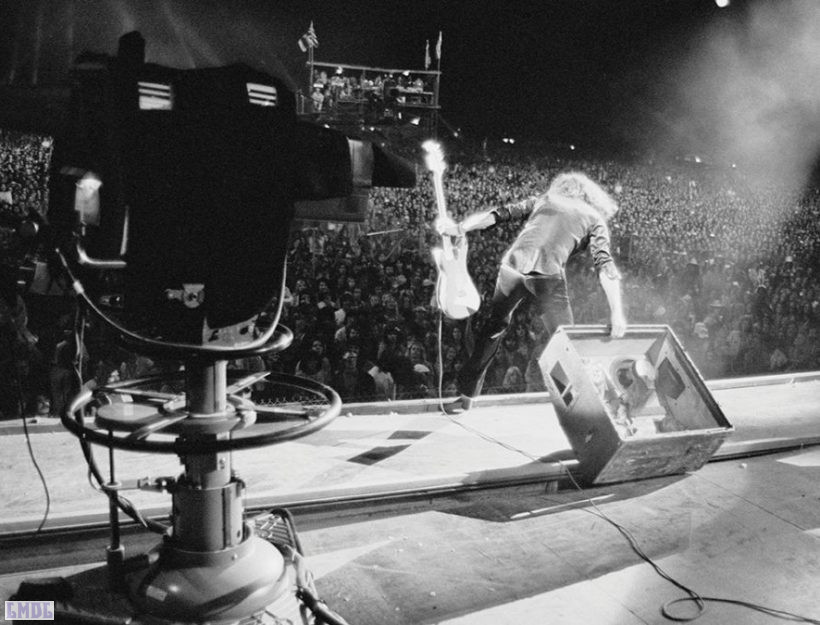
Par Fabrice DAEMS (guitariste amateur)
🎸 L’ENCYCLOPÉDIE DU MATÉRIEL DE RITCHIE BLACKMORE : DE LA FRAMUS AUX LACE SENSORS 🕵️♂️🔥
Avis aux puristes, aux techniciens et aux fans absolus ! On ne survole plus l’histoire, on plonge dans le rack personnel du “Man in Black“. Voici le détail chronologique complet de l’évolution de son matériel. 🤘✨
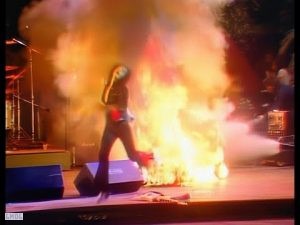
👶 1. L’APPRENTISSAGE : LA RIGUEUR AVANT TOUT (1956 – 1961)
La Framus Acoustique (1956) :
Offerte par son père à 11 ans. Un instrument rudimentaire mais fondamental. Son père lui avait dit : “Si tu ne joues pas correctement, je te la casse sur la tête“. Ritchie prend des cours de classique, ce qui forgera sa tenue de manche et son jeu au doigt.
La Framus Hollywood Star (1958) :
Sa première électrique. Une guitare archtop avec un micro flottant. Il commence à y explorer les sons de Duane Eddy.
La Hofner Club 50 :
Une guitare de transition sans ouïes, très prisée des jeunes rockers anglais de l’époque, avant de passer au niveau professionnel.
🍒 2. L’ÈRE GIBSON : LE SON DE LA “SESSION” (1961 – 1970)
Ritchie a été un “Gibson Man” pendant près d’une décennie !
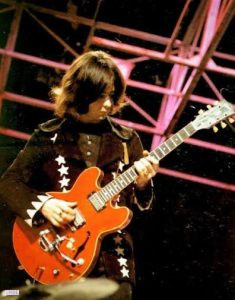
Gibson ES-335 (1961) :
Sa guitare principale pendant les années de studio (avec les Outlaws, Joe Meek, etc.) et les trois premiers albums de Deep Purple. C’est le son de Hush.
Gibson ES-330 :
On l’a parfois vu avec ce modèle (micro P90), mais la 335 restait sa préférée pour son sustain.
Le point de rupture : Lors de l’enregistrement de In Rock, il cherche un son plus tranchant. La 335, étant semi-creuse, créait des larsens incontrôlables face à ses nouveaux Marshall 200W. Il essaie une Fender Telecaster (celle de Steve Howe), mais n’aime pas le feeling.
⚡ 3. L’ÂGE D’OR DE LA STRAT & LE BRICOLAGE (1970 – 1979)
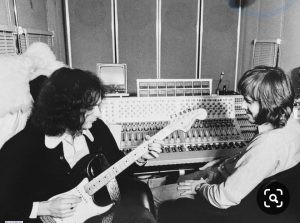
C’est ici que naît la légende. Il récupère une Strat (ex-Eric Clapton) et commence ses modifications :
Le Scalloping (Manche creusé) :
Inspiré par les touches des luths du 15ème siècle, il lime le bois entre les frettes. Le but ? Que ses doigts ne touchent que la corde pour un vibrato “violonistique” et des bends extrêmes sans friction.
Le “Blackmore Booster” :
Pas de pédales ! Il détourne un magnétophone à bandes Aiwa TP-1011. Il l’utilise comme un préampli pour saturer l’entrée de ses Marshall. C’est ce circuit qui crée le grain “crémeux” de Burn ou Machine Head.
Micros Fender Standards :
Contrairement aux idées reçues, il jouait sur des micros d’origine. Le micro central était systématiquement débranché et baissé pour ne pas gêner son coup de médiator.
🌈 4. L’ÈRE RAINBOW & LES ANNÉES 80 : LA PRÉCISION CHIRURGICALE
Ritchie veut un son plus “Hi-Fi” et puissant pour Rainbow et la reformation de Purple.
Micros Schecter F500 (Fin 70s / Début 80s) :
Il abandonne Fender pour Schecter. Ces micros ont de gros plots massifs (souvent confondus avec les SSL-4). Ils sont très brillants et permettent de percer le mix même avec beaucoup d’effets.
La Tige de Vibrato Custom :
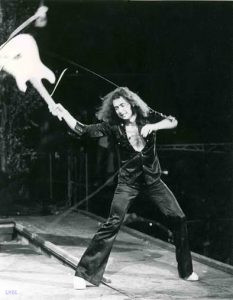
Lassé de casser les tiges Fender, il en fait forger des ultra-épaisses, plus longues et en acier massif, fixées de manière fixe. C’est ce qui lui permet de soulever la guitare par le vibrato !
Roland Guitar Synth (1984) :
Sur l’album Perfect Strangers, il utilise le système Roland GR-700. On entend des nappes de synthé doublant ses riffs, une grande nouveauté pour lui !

⚔️ 5. LES ANNÉES 90 : L’ÈRE LACE SENSOR ET LA FIN DE L’ÉLECTRIQUE
C’est la période la plus technologique avant son passage au folk médiéval.
Lace Sensor Gold :
Sur les tournées The Battle Rages On et le dernier Rainbow (Stranger In Us All), il utilise ces micros sans plots apparents. Pourquoi ? Ils n’ont quasiment pas de souffle (hum) et supportent les hauts niveaux de gain sans bruits parasites. Le son est plus compressé, très propre.
Électronique modifiée :
Ses guitares des années 90 intègrent souvent des circuits de “tone” modifiés pour garder des aigus cristallins même quand il baisse le volume de sa guitare (le secret de ses passages clairs).
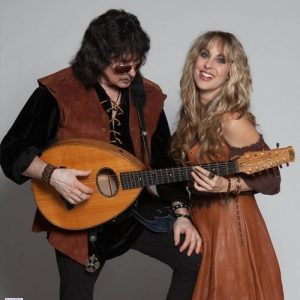
🏰 6. BLACKMORE’S NIGHT : LE RETOUR AUX SOURCES
Ritchie troque le cuir pour le velours.
Guitares Kawashima & Taylor :
Ses acoustiques principales, souvent équipées de systèmes de micros sophistiqués pour la scène.
Instruments Exotiques : Mandolines, Nyckelharpa (vièle à touches suédoise) et la Vielle à roue (Hurdy Gurdy).
La Strat Blanche :
Elle reste présente sur scène, utilisée pour les quelques morceaux Rock et les solos épiques.
Le saviez-vous ?
Les amplis de Ritchie (Marshall Major) n’avaient pas de réglage de “Gain”. Le seul moyen d’avoir de la distorsion était de mettre le volume sur 10. Imaginez la pression sonore sur scène avec 280 Watts réels ! 💣💥
Alors, êtes-vous plutôt “Gibson 1961”, “Strat 1972” ou “Lace Sensor 1993” ?
**
🎸 THE ULTIMATE ANTHOLOGY OF RITCHIE BLACKMORE’S GEAR: FROM FRAMUS TO LACE SENSORS 🕵️♂️🔥
Attention to all purists, technicians, and hardcore fans! We aren’t just skimming the surface anymore; we are diving deep into the “Man in Black’s” personal rack. Here is the absolute chronological breakdown of his gear evolution. 🤘✨
👶 1. THE LEARNING YEARS: DISCIPLINE ABOVE ALL (1956 – 1961)
The Framus Acoustic (1956): His very first guitar, given to him at age 11. It was a basic, hard-to-play instrument. His father famously told him: “If you don’t play properly, I’ll smash it over your head.” Ritchie took classical lessons, which forged his perfect hand positioning and fingerstyle technique.
The Framus Hollywood Star (1958): His first electric. A sunburst archtop with a floating pickup. This is where he began exploring the “twangy” sounds of Duane Eddy.
The Hofner Club 50: A hollow-body transition guitar without f-holes, very popular among young British rockers of that era before he turned professional.
🍒 2. THE GIBSON ERA: THE “SESSION” SOUND (1961 – 1970)
Many forget that Ritchie was a “Gibson Man” for nearly a decade!
Gibson ES-335 (1961): His main axe during his session years (playing for Joe Meek, The Outlaws, Gene Vincent) and the first three Deep Purple albums. This is the soul of the sound on Hush.
Gibson ES-330: He was occasionally seen with this P90-equipped model, but the 335 remained his favorite for its sustain.
The Breaking Point: During the recording of In Rock, he sought a sharper, more aggressive tone. The semi-hollow 335 produced uncontrollable feedback when faced with his new 200W Marshall stacks. He briefly tried a Fender Telecaster (borrowed from Steve Howe), but hated the stiff feel of the neck.
⚡ 3. THE GOLDEN AGE OF THE STRAT & DIY MODS (1970 – 1979)
This is where the legend truly begins. He acquired a Strat (formerly owned by Eric Clapton, according to legend) and started his famous modifications:
The Scalloped Fingerboard: Inspired by 15th-century lutes, he hand-filed the wood between the frets. The goal? To ensure his fingers touched only the strings, allowing for a “violin-like” vibrato and extreme bends without friction.
The “Blackmore Booster”: No distortion pedals here! He repurposed an Aiwa TP-1011 reel-to-reel tape recorder. He used it as a preamp to overdrive the input of his Marshall heads. This circuit created the “creamy” yet biting crunch heard on Burn or Machine Head.
Stock Fender Pickups: Contrary to popular belief, he played on standard factory pickups. The middle pickup was systematically disconnected and lowered flush to the pickguard so it wouldn’t interfere with his picking.
🌈 4. THE RAINBOW ERA & THE 80s: SURGICAL PRECISION
Ritchie wanted a more “Hi-Fi” and powerful sound for Rainbow and the eventual Purple reunion.
Schecter F500 Pickups (Late 70s / Early 80s): He moved away from Fender pickups. These Schecters had large, massive pole pieces (often confused with today’s SSL-4s). They were very bright and allowed his tone to cut through the mix even with heavy effects.
Custom Tremolo Arm: Tired of snapping standard Fender arms, he had ultra-thick, longer arms forged from solid steel. They were fixed rigidly to the bridge, allowing him to literally lift the entire guitar by the tremolo arm!
Roland Guitar Synth (1984): On the Perfect Strangers album, he used the Roland GR-700 system. You can hear synth textures doubling his riffs—a huge departure for him at the time!
⚔️ 5. THE 90s: THE LACE SENSOR ERA & TECH MATURITY
This was his most technological period before moving into medieval folk.
Lace Sensor Gold: During The Battle Rages On and the final Rainbow tours, he switched to these “pole-less” pickups. Why? They had almost zero hum and could handle high gain without parasitic noise. The sound became more compressed and very clean.
Modified Electronics: His 90s guitars often featured custom tone circuits to keep the highs crystal clear even when rolling back the guitar’s volume—the secret to his pristine “clean” passages.
🏰 6. BLACKMORE’S NIGHT: BACK TO ROOTS
Ritchie traded leather for velvet.
Kawashima & Taylor Guitars: His primary acoustics, often fitted with sophisticated pickup systems for the stage.
Exotic Instruments: Mandolins, Nyckelharpa (Swedish keyed fiddle), and the Hurdy Gurdy.
The White Strat: It is still present on stage, used for the few rock tracks and those epic, soaring solos.
Did you know? Ritchie’s amps (Marshall Major) had no “Gain” knob. The only way to get distortion was to crank the volume to 10. Imagine the sound pressure on stage with 280 actual Watts! 💣💥
So, are you Team “1961 Gibson,” “1972 Strat,” or “1993 Lace Sensor”?